
The automation and digitization breakthrough of the early 2000s enabled the unification of technology and the realization of a new, holistic quality-by-design approach. This breakthrough coincided with and supported the advent of ATMPs, which were a catalyst for manufacturers to redesign operations around quality-based advancements and automation that achieved risk reduction, higher yield, and end-to-end improvements in product stewardship. These products led to a wholesale shift in cost evaluations, facility and operational design, and supply chain dynamics, as manufacturers navigated smaller, high-value batches with truncated viability windows. Today, GMP principles for automation and manufacturing have been solidified by the harmonized revised Annex 1. Now, nearly three years from its enactment, where does the industry stand on automated technologies for manufacturing and their implementation?
Annex 1 and Beyond
The revised Annex 1 set the expectation for the Life Sciences industry to evolve and innovate towards higher standards of quality. The guideline’s holistic emphasis has been well covered, citing the need for a comprehensive contamination control strategy, advanced technology and automation, and robust solutions that prioritize product safety and quality, including the use of isolators and automated decontamination. Three years in, manufacturers continue to navigate compliance, and, even with some of the guidance’s finer points still subject to healthy discussion (PUPSIT as a notable example), Annex 1 has clearly moved the industry at large towards automation and better sterility solutions. Barrier technology, in particular, was highlighted as an area of compliance focus in the most recent PDA survey on Annex 1, and 75% of respondents reported at least 75% compliance with the regulation overall.
The main driver towards more advanced barrier technology is sterility assurance. The automated advancements in process monitoring, critical zone operations, data recording, and standardized technologies offered by an isolated, automated filling line are largely applicable to the cleanroom technology in general. The broader reality is that advanced automation makes GMP manufacturing more attainable, more efficient, and more scalable, and, as manufacturing operations are envisioned post-Annex 1 implementation, it will remain a focus. Regulatory moves to codify automation and additional GMP expectations show there’s a clear thread of digitization and automation that runs through cGMP initiatives globally; Recent updates include Annex 15 on qualification and validation, with a forthcoming draft recommendation to move the guidance to a requirement for active drug substance manufacturing, and the revised Annex 11, which stipulates a higher level of risk analysis and compliance expectations for computerized systems.

Navigating the Road to Technological Realization
The current state of automation can be described as a balance between improving advanced, robust technologies and the exciting push to uncover new solutions or novel applications of proven technologies. Many of the advancements in sterility, environmental and process monitoring, product dispensing, and yield continue to be improved upon, reaching new levels of automation, accuracy, and control, while younger technologies like virtual tools and artificial intelligence largely remain in the preliminary stages for large-scale adoption.
The priorities and goals that were elevated with the introduction of automated solutions fundamentally remain in play; the question now is how far the industry can go in implementation and process improvements and applying collective progress to future research and development. The industry finds itself at a place where, that while the technological advancements cited as part of Pharma 4.0 are well regarded for their potential applications to improve operational efficiency, augment critical aspects of drug development, and ultimately facilitate higher standards of quality, GMP principles and models for large-scale implementation still remain in need across the Life Sciences.
Frequently Asked Questions
Q: What are the keys to developing and implementing advanced technologies within a GMP setting?
The key to developing any advanced technology and setting it on a path to maturity is to have a keen understanding of the landscape across pharmaceutical manufacturing and the exact market need a given technology is addressing. Innovation should go beyond a single use-case and bespoke solutions, and be built to scale broadly, pushing the industry at large towards improvements in efficiency and sterility. The more unique the process requirements, the more challenging it can be to implement new solutions. A close partnership with drug product manufacturers and a strong understanding of the processes, parameters, and commonalities across challenges are essential.
Q: What should manufacturers look for out of the latest cGMP technology?
In fill-finish and aseptic processing, the innovations that scale are typically solutions that are simple yet robust. Carrying out sterile medicinal manufacturing includes far more than the specific operation of a feature or solution, and has numerous interconnected factors that come into play. The advancement must embody additional elements required for aseptic applications, including materials of construction, surface finishes, cleanability, airflow, particle emissions, sterilization (if product-contacting), ease of disassembly, and human factors if an operator needs to interact with the process or solution via glove ports in through the machine barrier. This level of robustness is critical to ensure that failure doesn’t result in a batch failure or a high quantity of rejects.
Q: Where have you seen automation emphasized most in drug product manufacturing settings in the past 1-3 years?
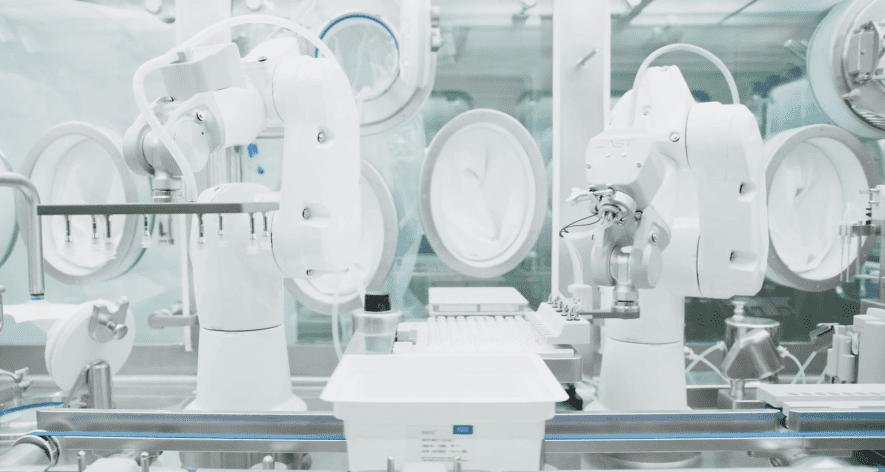
The focus on GMP aseptic environments is ultimately always on eliminating pathways and sources of contamination. Human beings are by measure the greatest microbial risk to the aseptic operation, and given this, the emphasis with automation and equipment design is the elimination of physical interaction and interventions. When and where elimination is not possible, automation should have strong mitigations in place to reduce risk and error. This is why AST has placed such a major emphasis on the use of intelligent systems and robotics within our equipment designs and development.
Q: The industry is approaching almost 3 years with the revised Annex 1. What are some key takeaways as the Life Sciences continues to navigate this guidance? What has been the global impact of guidelines on automation and advanced technology?
Annex 1 has applied greater scrutiny to the challenges and priorities inherent in modern aseptic processing (contamination control, the use of automation, product integrity), along with major emphasis on themes such as maintenance of first-air principles, assembly of direct and indirect product-contacting parts on the filling line post-sterilization, and PUPSIT (Pre-Use, Post-Sterilization Integrity Testing), to name a few. The industry is grappling with how to address these issues not only for new systems but also for existing aseptic processing equipment. Stakeholders are stepping up to the challenge as there’s continued focus on designs and automated solutions that promote Annex 1 compliance, including drastic reduction in the number of change parts and change part adjustments, expanding options and adoption of ready-to-use containers and components, fully automated options for environmental monitoring for active viable and settling plate changes, and systems that perform rapid detection of viable contamination.
To learn more about implementing cGMP technologies and other drug product manufacturing solutions from AST, connect with our team.


