

The following blog is part 2 of a series and has been expanded from CTO Steven Ng’s recent article in Cleanroom Technology. Read part one here: 5 Key Questions on Implementing Pharma 4.0™ Solutions for Fill-Finish.
Digital twin, a groundbreaking technology that’s a hallmark of Industry 4.0, has seen rapid adoption across multiple industries, including aerospace engineering, general manufacturing, energy, and more. In the pharmaceutical manufacturing and biotechnology sectors, while new technologies are implemented more cautiously by design, the application of digital twin technology, even in the initial stages, shows incredible promise.
In pharmaceutical manufacturing alone, multiple studies have explored how digital twin technology integrates with operational design, data management, and forecasting, showing a 30–45 % decrease in product development time and a 60–80 % increase in manufacturing yield.
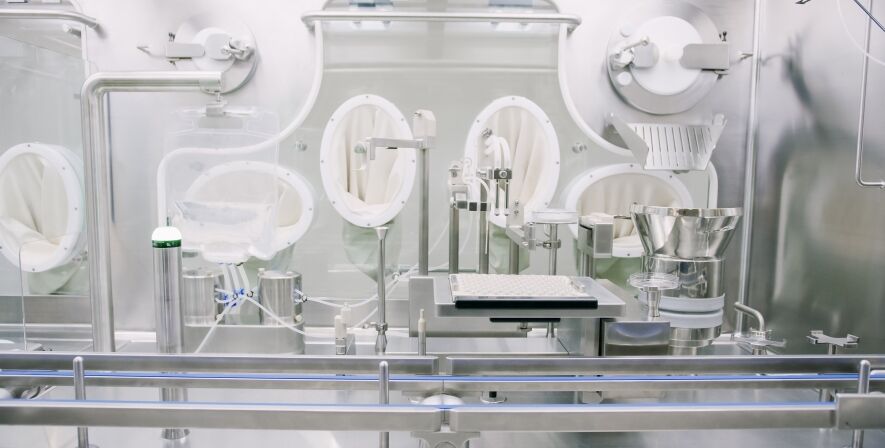
More broadly, digital twin technology is a direct outgrowth of Pharma 4.0 solutions designed to unify, streamline, and augment all aspects of aseptic operation, including product quality, data practices, and operator activities. When applied to drug product manufacturing environments, these principles and advancements work in concert with efficient cleanroom and operational design. Optimized filling systems, specifically utilizing isolator technology, reduce the aseptic burden and environmental and utility demands of the cleanroom, leading to a decrease in risk and cost over the life of the operation. Isolated filling lines should be outfitted with 4.0 technology, such as leak sensors, temperature and humidity sensors, environmental detection and monitoring, data feedback, and automation for routine operation and maintenance, all of which can be reflected in a dynamic, highly accurate virtual environment of a digital twin.
And because the aim is the same—a carefully controlled and monitored environment, similar types of technology and strategies utilized on aseptic processing equipment can be applied to the cleanroom at large. Improving operator workflows, preventative maintenance, real-time monitoring, and even measuring and improving utility efficiencies can all be addressed through digitization and automation.
Improving day-to-day efficiency and workloads of personnel has been a major area of focus as 4.0 technologies have gained traction. In addition to the operational and time-saving advantages of automation, other innovative solutions, such as remote monitoring and control (reducing ingress instances for entering a cleanroom space), CFD analysis, and virtual reality tools, should all be explored as design and operational solutions.
AST’s Digital Twin Tool
A digital twin is a dynamic virtual model that synthesizes real-time data, physical operations, and virtual environments in an exact digital replica of a machine, system, or complete manufacturing operation. It consists of three parts: The physical machine, all data and parameters that influence or are generated by that machine, and the digital environment where the “twin” – the exact digital replica – exists.

This virtual duplicate can run alongside the physical system in real-time (mirroring), offering an enhanced level of monitoring. It incorporates real-time data and parameters into the twin model, enabling complete integrated diagnostics and record-keeping. This virtual combination of the digital, data, and physical spaces also enables accurate simulations for a variety of pharmaceutical manufacturing purposes, including formulation and process development, error detection, predicted production outcomes, and scale-up strategies for operations and facilities. Tools like these will play an important role in the full realization of automation and digitization across our industry.
Three Use Cases for Fill-Finish
System monitoring with ‘Run Ahead’ function – Having the ability to monitor and analyze the filling and closing process is an essential part of an operation. Real-time mirroring with “look-ahead” process and motion verification provides operators with a higher level of process control. The digital twin of the system mirrors the physical filling machine. While mirroring, the digital twin will run slightly ahead of the physical system to detect potential interference or errors, and can stop the physical system before an issue occurs.
Recipe verifications – Pre-production and recipe validation are key areas that a digital twin can streamline and improve. Because the digital twin is a high-fidelity model that offers special and kinematic equivalents, recipe assumptions and variables (like containers and components) can be accurately tested. The DT will simulate the operation with a new recipe and show the user if the recipe has an error, highlight the problematic recipe item, and identify the location of the potential fault.
Performance simulations – High-resolution performance modeling offers the ability to segment a machine in a commercial production state and run a series of accurate production simulations using various recipe and runtime settings. Once operational variables are validated, they can be input into the digital twin performance modeling and executed at computational speed to relay production results to the user, e.g., times to complete all fill/close operations, expected units per hour, etc. This is useful for process improvement in high-value production operations, such as forecasting time differentials in the processing of targeted therapeutics with shorter viability windows.
In order to make advanced solutions like digital twin more feasible, standardized, and practical within the holistic vision of Pharma 4.0, there must be a clear path to integration. Complete alignment across technical platforms and digital infrastructure that can store, access, synthesize, and analyze vast amounts of data is the foundation of real-world pharmaceutical manufacturing operations. The future of sterile product manufacturing lies in the implementation of these innovative concepts and solutions.
To learn more about digital twin and other drug product manufacturing solutions from AST, connect with our team.


