

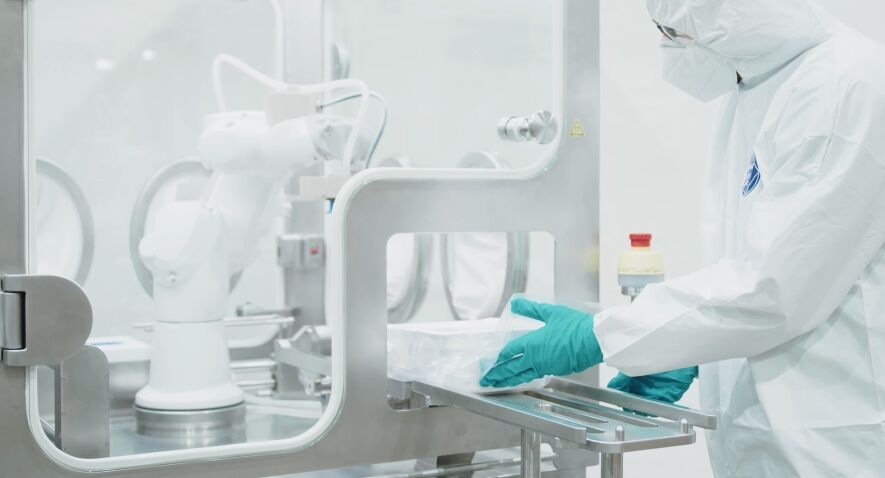
Ready-to-use container technology is a pivotal advancement in pharmaceutical manufacturing and occurred alongside the development and rise of patient-centered medicine. Traditionally, conventional parenteral manufacturing typically relied on large-volume production, sample-based and destructive in-process checks, and bulk containers that required sterilization via in-house equipment before filling. With the arrival of Advanced Therapy Medicinal Products (ATMPs), new standards of processing needed to be established to meet the inherent quality needs in cell and gene therapies, advanced therapeutics, and more.
These considerations included designing filling operations around smaller batch sizes and advancements in processing that protected highly sensitive products with shortened viability windows, including non-destructive IPC and pre-packaged, pre-sterilized containers. The variability of patient-centered parenteral products also made processing flexibility a non-negotiable. While pre-filled syringes were the earliest iteration of the technology, there was a need for platforms that expanded across formats to standardized and presterilized vials, syringes, and cartridges.
The rise of commercial RTU platforms, starting around 2007, eliminated the need for time-consuming preparation and equipment needs related to container washing, sterilization, and depyrogenation. Practically speaking, the advancement changed how manufacturers designed and executed operations. Not only could manufacturers now save crucial time (multiple hours in preparation alone), but the footprint and additional equipment needs reduced by RTU container technology led to a lighter, agile manufacturing framework. Functionally, going away from format-specific upstream container preparation equipment drastically decreased operational changeover and enabled operations to alternate between formats in a fraction of the time.* Aseptic processing could now be designed for multi-modal production on a single line, and when combined with single-use product contact technology and aseptically-compatible change parts, formed the operational foundation of patient-centered medicine.
| Preparation Stage | Traditional Process Duration (Est) | Ready-to-Use Advantage | Total Time Saved (Est.) |
|---|---|---|---|
| Container Washing | 20 seconds (full preparation) per vial | Eliminates this process | Varies by batch size |
| Depyrogenation (Continuous Tunnel) | 30 min-2 hr total (Est.) | Eliminates this process | 30-120 minutes |
| Depyrogenation (batch oven) | Up to 5 hours | Eliminates this process | Up to 5 hours |
| Stopper sterilization | 60-90 minute cycle | Eliminates this process | 60-90 minutes |
| Line changeover | Varies from hours to days | Format changeover in minutes | Hours to Days in reclaimed time |
*AST equipment leverages format changeover times of 15 minutes or under.
Beyond the practical benefits of requiring less equipment and processing time, RTU containers have a significant cGMP advantage as well. Standardized platforms offer robust, documented validation available from the format manufacturer, removing that critical process-heavy step from fill-finish operations. Additionally, from a risk analysis perspective, RTU is a clear net positive in its inherent elimination of human intervention, particularly when paired with automated aseptic filling equipment designed to support these platforms. There’s also less overall risk from traditional processing factors, as many RTU configurations remain sealed until the point of use, opened under Grade A laminar airflow.

Technical Highlights and Outlook
From a processing perspective, the technical benefits of RTU containers lie in their accessibility, sterility, and standardized compatibility with multi-format filling lines. Additionally, much of the design impetus behind the technology was driven by innovative breakthroughs in biologics and ATMPs, with final containers designed to support and, in some cases, even protect certain product formulations.
Supports a robust CCS
While RTU containers are not explicitly mentioned in Annex 1, the technology and inherent advantages are strongly inferred and support an active, comprehensive Contamination Control Strategy. The revised regulation has a strong emphasis on reducing operator interventions and particulate risk, both of which are specific design considerations of presterilized container technology. It’s important to note that while the RTU technology does remove the sterilization validation process from the end user, because sterilization happens offsite, drug manufacturers must have a qualified risk strategy in place for factors related to transport and handling from the offsite shipping location to the point at which sterile containers are introduced into the filling operation.
Widespread standardization and adoption

Product compatibility
High-speed applications
The future of RTU container technology lies in greater standardization, improvements in secondary packaging design and filling technology to enable better throughput, and designed-in quality improvements (low-particle designs, and non-contact nest configurations). The benefits and established use history of pre-sterilized syringes have long made it the preferred option for in-nest, high-speed filling. And RTU vials are seeing growing use in high-speed applications, as processing improvements continue to be made. Tray formats in particular are seeing increasing use in high-speed filling lines due to their ability to provide higher packaging density and easier access to vials for removal and processing. Filling line designs that minimize transport time and mechanical points of failure will be a point of emphasis in high-speed multiformat manufacturing going forward.
Market Emphasis – Increased access & commercialization for advanced parenteral products
The history of ready-to-use containers is, at its core, a story about the parenteral products they deliver. Many of the products that arose with RTU technology as a novel modality are now maturing, multi-generational products. Therapeutic proteins, for example, are now being leveraged for targeting small-molecule delivery in antibody-drug conjugates (slated to see estimated projected growth to around $35 billion by 2035), while the foundational field remains a consistent area of investment growth, constituting the top product pipeline by respondents for both R&D and commercial manufacturing in the 2025 CRB Horizons Life Sciences report. Compounded pharmaceutical manufacturing has also seen extraordinary growth over the last 5 years, driven by telehealth/direct-to-consumer pharmacies and the widespread influx of GLP-1s. With injectable products accounting for roughly 90% or more of the market, and aggressive growth with 190 obesity-related products in pipeline development, the demand for GLP-1s isn’t slowing. The pharmaceutical market reflects the clear advantage of RTU filling machine platforms that offer process and format flexibility across multiple different products.
When combining automation and robotic capabilities with standardized RTU platforms for vials, syringes, cartridges, IV bags, and more, the gains in time, productivity, efficiency, and scalability translate to demonstrably faster market availability and improved time-to-patient.
Reach out to our team today to learn how different semi-automated or fully automated filling solutions can support your processing or product quality requirements, wherever you may be in the drug development process.


